
Compliance
The Records You Are Asked For
Meeting a standard comes down to what you can show at survey: a unit’s record on a given day, and what your team did when it went out of range. Mogul keeps that record continuously, along with who responded to each excursion and the calibration certificate behind each sensor. Our team knows what surveyors ask to see.
The standards your facility answers to
- Joint Commission
- CDC Vaccines for Children
- CAP
- HACCP
What does a surveyor actually ask for?
The records requested at survey are not always the ones a facility has. A surveyor picks a unit and a date and asks to see what the temperature did, who looked at it and what happened when it went out of range. A paper log answers some of that, some of the time. Readings are taken once or twice a day by whoever is on shift, weekends and holidays leave gaps, and a corrective action that was taken but never written down reads, to a surveyor, as one that was never taken.
Gaps like these are not a sign of a careless team. They are what happens when a busy clinical team is asked to be a recording instrument as well. They still become findings.
An older monitoring system can leave the same gaps when nobody is left who knows how to get the record out of it. The aim is a record that answers the surveyor’s questions without your staff assembling it by hand, kept by people you can call when you need it.
What each standard asks for
Each standard your facility answers to asks a slightly different question of the same records.
The Joint Commission
For medication storage, the Joint Commission expects medications to be stored according to the manufacturer’s instructions. It has said it does not specifically require a temperature log for medication refrigerators, but it does expect a process that keeps each unit within the range its contents require, names who is responsible and defines what happens to medication from a unit that has gone out of range. For the building itself, its Environment of Care standards cover ventilation in critical areas such as operating rooms: pressure relationships, air exchange, filtration, temperature and humidity. Surveyors ask staff how those are monitored, where the records are kept, and what they do when a reading is out of range. The rooms that have to hold their pressure are covered below.
CDC Vaccines for Children
Clinics enrolled in Vaccines for Children must use a digital data logger for continuous monitoring, check and record minimum and maximum temperatures at the start of each workday, keep a current calibration certificate for each logger, and follow a set procedure when a unit leaves its range. State programs administer the requirements, so the detail varies. Vaccines for Children sets out what the program expects.
CAP
Laboratories accredited by the College of American Pathologists define an acceptable range for every temperature-dependent piece of equipment, keep a record of its temperatures and show evidence of corrective action whenever that range is exceeded, including an evaluation of the contents. Where an automated system replaces manual readings, laboratory staff must have immediate access to the data, so that someone can act while it still matters.
HACCP
In food service, a HACCP plan names the critical control points, sets a limit for each, and expects each to be monitored, with corrective action and records to show it. The same continuous record serves it.
Which rooms have to hold their pressure?
An operating room, a laboratory or a chemo preparation area has to stay at the right pressure relative to the spaces around it. An operating room is held positive, so air moves out under the door and away from an open surgical site. A chemo preparation room, and many laboratories, are held negative, so drug residue, infectious material and fumes stay where the controls are. In those rooms, the people protected first are your own pharmacists, technicians and laboratory staff.
Nothing about a room shows when that relationship has been lost. A door propped open, a filter loading up or a damper that sticks can reverse the airflow while the room looks exactly the same. Whether a room holds its pressure is something Joint Commission surveyors look at, and they expect your staff to know how it is monitored and what they do when it is lost.
Mogul monitors room pressure continuously, alongside temperature and humidity, against the range your facility sets for each room, and alerts your on-call team when one drifts.
What did your team do about the excursion?
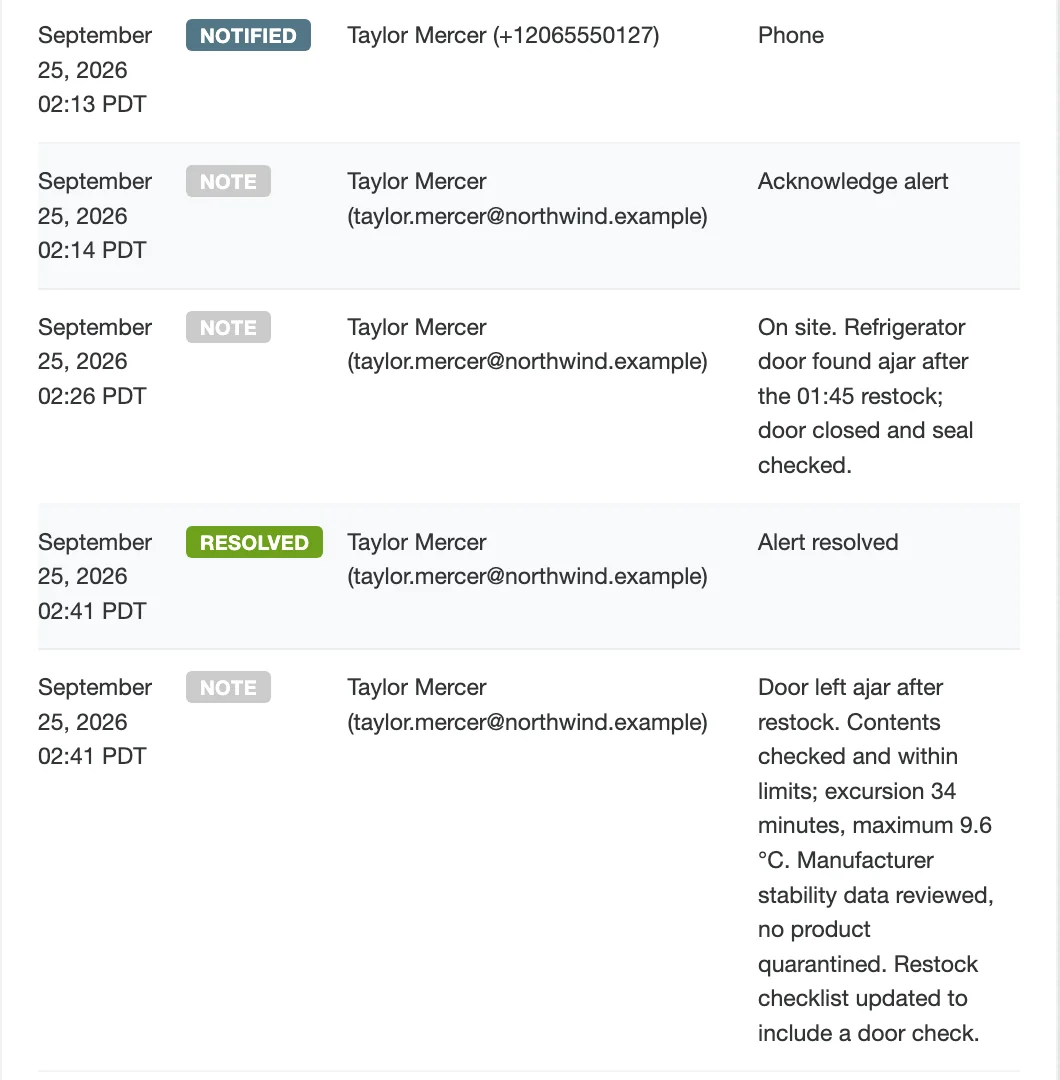
An excursion on its own is a finding waiting to be written. What a surveyor wants to see is what your team did about it. In Mogul, every alert is closed by a named staff member, and you can require a note of the corrective action taken on every one, so the response sits in the record beside the event it answers.
Is there a calibration certificate behind every reading?
A continuous record is only as credible as the instrument behind it, and surveyors know it. Mogul holds a calibration certificate for every sensor with its next due date, recalibrates each one on site before the certificate lapses, and replaces any sensor that cannot be calibrated.
Which reports arrive without anyone asking?
Daily, weekly, monthly and Vaccines for Children reports are delivered as PDFs, on a schedule, to the people on your account who need them: the unit manager, your quality lead, your pharmacy director.
What else is in the record?
- A change audit trail, so when someone asks who changed an alarm limit and when, the answer is already written down.
- Retention and export, so a request for a date last spring is a search rather than a hunt through a filing cabinet.
- A percent-in-range score for each unit and site, a single figure for the quality committee or the board.
Your facility is surveyed against these standards; Mogul keeps the records your team shows the surveyor. Which of them matter most depends on what your facility stores and where it is, and that is the conversation worth having first.
Common questions
Does the Joint Commission require a refrigerator temperature log?
The Joint Commission has said it does not specifically require a temperature log for medication refrigerators and freezers. It does expect medications to be stored according to the manufacturer’s instructions, a process that keeps each unit within the range its contents require, and a defined process for medication from a unit that has gone out of range. A continuous record, with the response to each excursion attached, is how your team shows that process working.
Does automated monitoring replace our manual temperature logs?
For most units, routine logging stops being a manual task. Some programs still expect a person to check the record: Vaccines for Children, for example, asks for minimum and maximum temperatures to be checked and recorded at the start of each workday. See Vaccines for Children, and confirm the expectation with the body that surveys you.
What do surveyors look for when a temperature goes out of range?
The response, as much as the excursion. CAP asks for evidence of corrective action whenever a temperature-dependent unit leaves its acceptable range, including an evaluation of its contents, and CDC guidance for vaccines asks that every step taken be documented. A record that shows the excursion and nothing after it tends to become a finding.
Does using Mogul mean our facility meets the standard?
No monitoring system can say that on your behalf. Your facility is surveyed against its standards, and Mogul keeps the records surveyors commonly ask to see: a continuous history for every unit, the documented response to each excursion and a calibration certificate for every sensor.
What pressure differential should our rooms hold?
That depends on the type of room and on your facility’s own design and policies, so it is not a single number. Your facilities engineering and infection prevention teams set the range for each room, and Mogul monitors against the range you specify.
Can you produce the record for a date months ago?
Yes. The history for each unit is kept and can be exported, so a question about last March has an answer. How long your facility must keep records depends on the standards and state rules that apply to you, and it is worth confirming before a survey rather than during one.
Which standards are you surveyed against?
Tell us which standards your facility is surveyed against, and we will talk through the records you are asked for and how Mogul would keep them.