
Sensors & Hardware
What Gets Installed
Small wireless sensors in the units and rooms you choose, and a gateway that carries their readings to the Mogul platform. The same team surveys your site, installs everything and keeps every sensor calibrated.
What does your facilities team need to know first?
Before anyone signs off on a monitoring system, facilities needs to know what goes into the building, and what it disturbs on the way in. Facilities teams are right to be wary of cable runs through ceilings, and of one more system to look after.
The answer here is deliberately small. A wireless sensor goes into each unit or room you want watched, and the sensors report over a private wireless network that Mogul installs and maintains, repeaters included. The sensors do not use your network, and nothing is cabled through the building: a repeater needs only a standard outlet.
The one fixed item is the gateway on site, which sends the readings securely over the internet to the Mogul platform. At most, your firewall needs to allow it one outbound port.
If you are replacing an older wired system, this is usually the biggest difference: the installation is far less disruptive.
What can the sensors monitor?
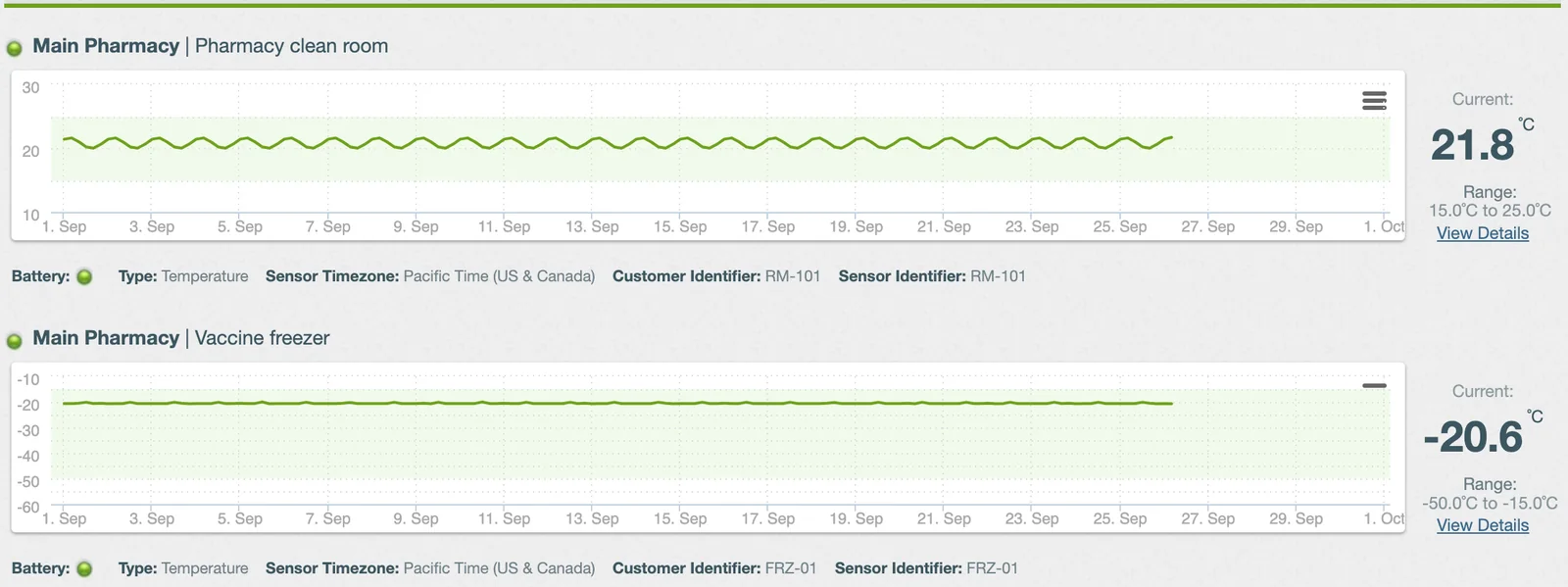
- Temperature in refrigerators, freezers and the rooms that hold medication, vaccines, reagents and specimens.
- Humidity wherever storage conditions depend on it.
- Room pressure in operating rooms, laboratories and chemo preparation areas. See room pressure on the compliance page for which rooms, and why.
- Door access on unit doors and room doors, so you know when one has been left open.
Each unit is watched against the range it has to hold, whether that is 2–8 °C for a vaccine refrigerator or well below freezing for a laboratory freezer.
Who installs it?
We do. Mogul surveys your site, specifies what each unit and room needs, installs the sensors and gateway, and supports the system afterward. You are not buying sensors and working out the rest yourself: the people who put the system in are the people you call about it.
How is calibration handled?
A sensor is only as trustworthy as its last calibration, and surveyors check it. CDC’s guidance on vaccine storage, for example, expects each temperature monitoring device to have a current Certificate of Calibration Testing, kept where it can be produced when asked.
Mogul holds a calibration certificate for every sensor with its next due date, recalibrates each one on site before the certificate lapses, and replaces any sensor that cannot be calibrated. When a surveyor asks for a certificate, it is on file against the sensor it belongs to, rather than in a drawer somewhere.
Will it fit the way your facility is laid out?
Every building is different: the number of units, how far apart they sit and what walls and floors lie between them. That is what the site survey is for. We look at your facility before we propose anything, so what we install is fitted to the building you actually have rather than taken off the shelf.
Once the system is in, adding units, floors or buildings is simple and inexpensive, because the private network that carries the readings extends with them.
What would we install at your site?
A site survey tells you which units and rooms we would monitor, where everything goes, and what the installation would involve for your team.